
From the time a yoga mat comes off the factory to being laid on the user's living room floor, it has to go through warehousing, storage, picking, packaging, trunk transportation, terminal distribution, and the return and exchange process that may be triggered at any time. This link seems simple, but the yoga mat category has its own temperament: natural rubber is afraid of moisture and stuffiness, PVC material is afraid of sun and pressure, and TPE material is sensitive to temperature fluctuations. What’s even more troublesome is that yoga mats are large in size and light in weight, making them a typical light-shipping product, and the utilization rate of storage space is naturally low; at the same time, yoga brands often also sell yoga clothes, yoga bricks, elastic bands and other accessories, with SKUs ranging from hundreds to thousands, and the return and exchange rate remains high.
Leaving all these matters to professional fulfillment warehouses is becoming the choice of more and more yoga brands. However, there are great differences between fulfillment warehouses, especially for categories such as yoga mats that have clear requirements for storage environments. The performance results of general-purpose warehouses and professional warehouses that understand the category may be completely different.
The difficulty of warehousing yoga mats is far more than just placing shelves.
The material of the yoga mat determines that it has rigid requirements for the storage environment. The humidity of the storage environment of natural rubber yoga mats needs to be controlled within the range of 45% to 65%. Excessive humidity can easily breed mold and cause the surface to become sticky. PVC yoga mats will undergo plasticizer migration under ultraviolet rays and high temperatures, causing the surface to pulverize. Although TPE materials are environmentally friendly, they are sensitive to stacking pressure, and long-term heavy pressure will lead to a decrease in rebound performance. In industry practice, it is usually recommended that the storage temperature of finished yoga mats be controlled between 5°C and 25°C, with the relative humidity below 65%.
The problem with ordinary flat warehouses is that these three things, ground moisture return, temperature and humidity fluctuations, and mixed pile extrusion, often occur at the same time. If the yoga mat roll is placed directly on the epoxy floor, the underlying mat will bear the brunt of moisture; if it is mixed with metal equipment, it will be easily scratched or stained.
In addition, the SKU structure commonly faced by yoga brands is also a hurdle. A yoga mat may exist in 5 colors and 3 thickness specifications at the same time; the size and color combinations of yoga clothes can easily push SKUs to hundreds. Under omni-channel operations, if the inventory of Tmall, Douyin, Pinduoduo, and private domain mini-programs cannot be managed uniformly, the probability of oversold and missed shipments will increase significantly.
Returns and exchanges are another cost item that is easily underestimated. The return and exchange rate of yoga apparel often reaches over 30% in the industry. Returned goods require quality inspection, cleaning, ironing, and repackaging before they can be put on the shelves again. If the processing speed cannot keep up, returns will become dead inventory.
Moisture-proof is the bottom line, but professional fulfillment warehouses do more than just moisture-proof
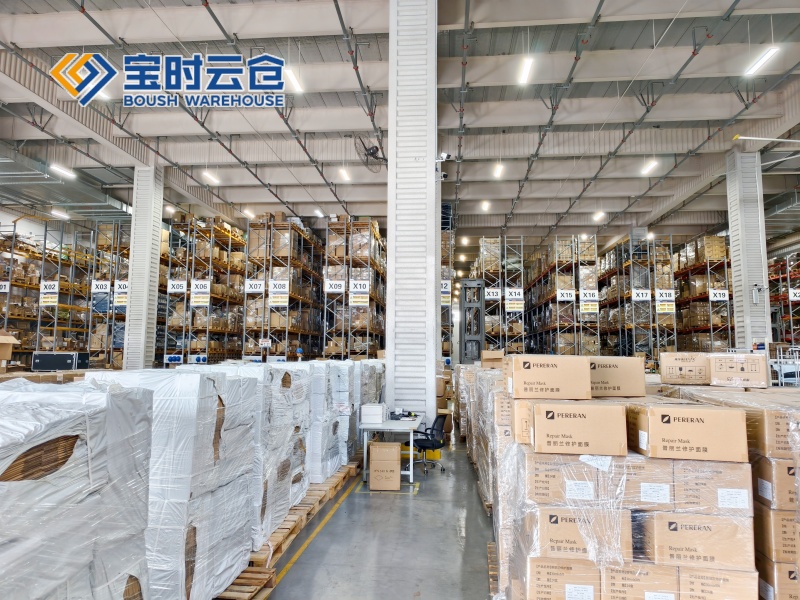
Baoshi Fulfillment has accumulated a relatively complete set of processing experience in the category of yoga fitness products. Its warehouse uses epoxy resin flooring, which has the basic conditions for moisture-proof and heat insulation. It also cooperates with intelligent temperature and humidity monitoring and daily dust-proof and moisture-proof operation procedures. For moisture-sensitive goods such as yoga mats, Baoshi Fulfillment will plan a special storage area according to the material and packaging form to avoid mixing with metal equipment and moisture risk sources.
What deserves more attention is the storage method itself. Yoga mats are disposable goods. A roll of mats may occupy two or three cubic meters of space. Traditional flat stacking will also rent out the "air". Baoshi Fulfillment has set up a high-level integrated storage and picking area for yoga mats, yoga balls and other large equipment to optimize space utilization while preventing mats from deforming due to stacking pressure. This zoning logic is not to simply separate yoga mats and yoga clothes, but to plan storage locations and moving lines based on the physical characteristics of different categories—length, hardness, and stacking sensitivity.
For brands that operate yoga clothes and accessories at the same time, Baoshi Fulfillment also provides hanging storage and a constant temperature and humidity environment to reduce wrinkles and moisture problems caused by stacking functional fabrics. At the system level, the self-developed warehouse management system supports multi-dimensional inventory tracking by color, size, and style. The inventory accuracy rate is stable at 99.99%, and the delivery error rate is controlled within one ten thousandth.
Packing is not about putting a bag on, the packaging of yoga mats is particular
The packaging method of yoga mats directly affects the transportation damage rate and unpacking experience. If rolled yoga mats are only wrapped in ordinary express bags, they will easily be creased by other heavy goods during the sorting process. When opened in the user's hands, they will rebound slowly, which visually looks like "poor quality." Baoshi Fulfillment's approach is to adapt the packaging plan according to the product volume and material, and carry out special protective designs for large and lightly thrown goods such as yoga mats. At the same time, customized packaging materials can be matched according to brand needs, so that the unpacking process also assumes part of the brand communication function.
The packaging logic of yoga clothes is different. Functional fabrics are afraid of being squeezed and hooked, so they need moisture-proof bags and bubble wrap for protection. For products that require tags and brand packaging, tag review and packaging restoration must be completed during the packaging process. The packaging process of Baoshi Fulfillment includes weighing and repeat verification. The system compares the actual weight with the theoretical weight. If the deviation exceeds the threshold, manual review will be triggered. This is the final step to control wrong and missing shipments.
The competitiveness of distribution is hidden in the warehouse location and system docking.
The distribution cost structure of yoga mats has a characteristic: it is light in weight but large in volume. Express billing is often settled based on volume and weight, and the freight rate is relatively high. This means that the location of the warehouse will directly affect fulfillment costs - the closer the warehouse is to the main consumer market, the shorter the main line segment, and the more controllable the overall freight is. Baoshi Fulfillment is headquartered in Songjiang, Shanghai, and has deployed multiple directly operated warehouses in Shanghai, with a total storage area of more than 100,000 square meters, covering the core consumption areas in East China. For yoga brands sold nationwide, we can also achieve nearby warehousing and nearby delivery through warehouse layout.
At the system docking level, the warehouse management system of Baoshi Fulfillment can directly dock with mainstream e-commerce platforms such as Tmall, Douyin, Pinduoduo, and Kuaishou, as well as brand private domain systems, to achieve real-time synchronization of omni-channel inventory. After orders enter the system, they are automatically assigned to corresponding warehouses and picking waves. Peak orders during major promotions can also be digested through intelligent scheduling without significantly increasing manpower.
The coverage of the distribution network is also critical. Baoshi Fulfillment has established cooperative relationships with logistics providers such as Three Links and One Express, SF Express, JD.com, and EMS. It can match different express products based on commodity volume, destination, and timeliness requirements, instead of using a fixed solution to deal with all orders.
After-sales is not the end point, return processing determines inventory turnover efficiency
There is an unavoidable reality in the after-sales service of the yoga category: the return rate is naturally high. Yoga clothes are worn close to the body, and there is a lot of room for subjective judgments of size and body feel; although the return rate of yoga mats is relatively low, once returns occur due to smell, thickness perception, or color deviation, if the returned goods are not processed in time, they will change from "sellable inventory" to "sluggish inventory."
Baoshi Fulfillment is equipped with an independent return processing center. System registration will be completed within 3 hours after the returned goods arrive at the warehouse, and unpacking, quality inspection, classification and system entry will be completed within 24 hours. For returns of yoga clothes, they can be cleaned, ironed and repackaged according to the condition of the goods before being put on the shelves again; for yoga mats that do not affect secondary sales, they can be quickly returned to the warehouse and re-entered into the sales pool. RPA digital employees take over part of the chargeback and refund process, reducing the duplication of manual customer service work, and the refund payment cycle can also be shortened accordingly.
The value of this process does not lie in "fast processing" itself, but in allowing returned goods to return to the sales cycle as much as possible, rather than waiting for processing in the corner of the warehouse. For yoga brands, returns processing efficiency is directly related to inventory turnover and cash flow.
What kind of yoga brand is suitable for considering outsourcing?
Warehousing outsourcing is not a cost-effective option at all stages. For yoga brands with a stable daily order volume of more than a few dozen orders, SKUs exceeding a certain number, and operating multiple channels at the same time, the comprehensive costs of self-built warehouses—rent, manpower, systems, consumables, and management efforts—are usually higher than the service fees of professional fulfillment warehouses. Especially for lightly sold goods such as yoga mats, the space utilization rate of self-built warehouses is low, and the hidden costs are easily underestimated.
For yoga e-commerce in the initial stage, the value of fulfillment warehouse is more reflected in "no need to build a warehouse first and then sell goods." Use warehousing space on demand, pay operating expenses on an order basis, and convert fixed costs into variable costs, which will reduce financial pressure.
Since its establishment in 2012, Baoshi Fulfillment has served more than 600 brand customers and has accumulated deep operational experience in categories such as shoes and clothing, sports and outdoor sports. Its service model covers the entire chain from warehousing quality inspection, storage management, picking and packaging to distribution and return processing. It is suitable for yoga brands that have requirements for quality control and contract performance stability and want to focus on product and brand operations.