A friend who has been a men's clothing e-commerce business for eight years recently complained to me: Last year's Double Eleven, the warehouse was out of stock, and more than 2,000 orders were backlogged for three days before being sent out. The store's rating dropped from 4.8 to 4.5, and the traffic was cut in half. He said that the front-end investment cost hundreds of thousands, while the back-end warehousing ate up all the profits and reputation.
This is not an isolated case. Stories of men's clothing brands failing in the warehousing and logistics process happen almost every day. But at the same time, the penetration rate of the domestic clothing fulfillment warehouse industry will exceed 62% in 2026, and more and more men's clothing brands are handing over the "heavy burden" of warehousing to professional teams.
Is it suitable for men's clothing brands to settle in Yuncang? Today we will do an in-depth dismantling from the three dimensions of industry pain points, operational logic and practical cases.
Men's clothing warehousing is far more complicated than imagined
Many people's reaction is: Men's clothing styles are simple and there are few SKUs. How difficult can it be to store them?
This is a typical cognitive misunderstanding. An ordinary men's sweatshirt covers multiple colors and sizes, and the number of SKUs can easily exceed 10; if it involves multi-style and multi-season products, the total number of SKUs can reach thousands or even tens of thousands. A POLO shirt comes in seven sizes from S to 4XL. Each size is multiplied by five or six colors, and one style can have thirty or forty SKUs. Dark blue and navy blue are almost indistinguishable under warehouse lights. Pickers distinguish color numbers and sizes with the naked eye, and the wrong and missing items become a common occurrence.
The return rate is the second hurdle. In the past, the online return rate for men's clothing was only 5% to 10%, but industry data from 2025 to 2026 shows that this number has climbed to 30% to 40%. This means that for every ten pieces of clothing sent out by a merchant, three to four may have to go through the reverse logistics process. Every step of the quality inspection, cleaning, ironing, and re-shelving of returned goods requires professional process support.
Seasonal fluctuations cannot be ignored either. Men's clothing has a short seasonal change cycle, and orders surge during major promotions. Warehouse outflows and delivery delays are the norm; in the off-season, warehousing resources are wasted. Under the traditional self-built warehousing model, manpower deployment and site flexibility during off-peak seasons are unsolvable problems.
There is another detail that is easily overlooked: the quality control of mid- to high-end men's clothing. Categories such as suits and coats have strict requirements for hanging storage, dustproofing and wrinkle-proofing. The flat stacking mode of ordinary warehouses can easily cause clothes to wrinkle and become damp. The product quality that the brand spent a lot of effort on polishing was destroyed in the warehousing process.
When the total holding cost of self-operated warehousing exceeds 8% of GMV, the value inflection point of migrating to a professional fulfillment warehouse has arrived. The combination of these pain points has prompted more and more men's clothing brands to re-examine their warehousing strategies.
What practical problems can fulfillment warehouses solve?
The core of the value of fulfillment warehouse is to convert fixed costs into variable costs, allowing brands to focus their limited manpower and funds on product design and brand marketing.
At the SKU management level, professional fulfillment warehouses realize digital management and control of each product through intelligent WMS system and barcode level management. Taking Baoshi Fulfillment as an example, it has independently developed a matrix of digital tools such as SWMS smart warehousing management system and OMS order management system, which connects the full-link data nodes from warehousing, storage, picking, packaging to reverse returns. The inventory and picking accuracy rate is stable at above 99.99%, and the delivery error rate is controlled within one ten thousandth.
In terms of return processing, Baoshi Fulfillment has created an extremely fast return closed-loop system for shoes and clothing. Registration of returned items is completed within 2 hours after they arrive at the warehouse, and the entire process of unpacking, quality inspection, repair, and secondary shelving is completed within 24 hours. For slightly defective products, simple repair services can also be provided to quickly return the sellable products to stock.
At the level of flexible production capacity, the advantages of fulfillment warehouses are even more obvious. Baoshi Fulfillment's goods-to-person smart warehouse can manage multi-customer projects, massive SKUs and daily average orders. Its personnel efficiency is greatly improved several times compared with the traditional model, and it can flexibly cope with business peak periods such as major sales. Spend less in the off-season and flexibly expand in the peak season, so merchants don’t have to pay for idle warehouse capacity.
The adaptation logic of men's clothing category to fulfillment warehouse
Not all men's clothing brands are suitable for entering Yuncang. But from the perspective of category characteristics, the fit between men's clothing and the fulfillment warehouse model is quite high.
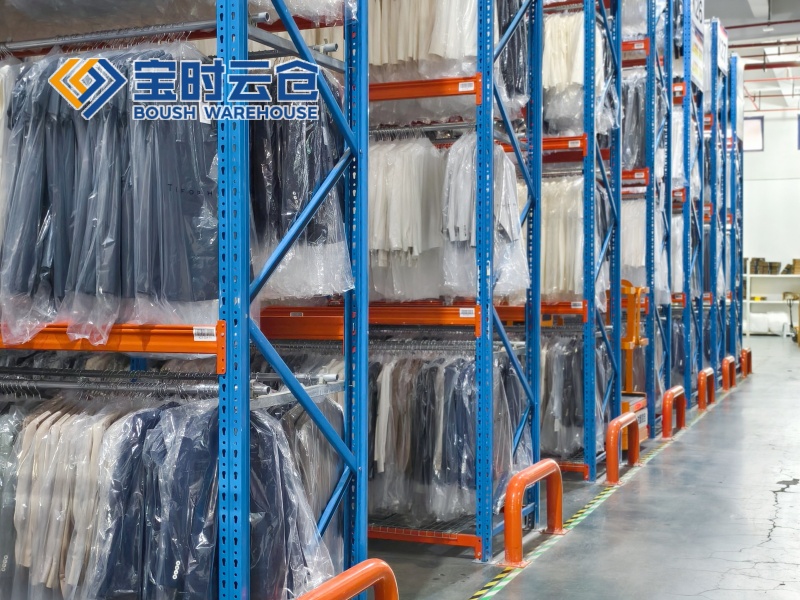
The degree of standardization of men's clothing is relatively high - the styles are classic and the styles are stable, and they do not iterate design elements as frequently as women's clothing. This feature allows the fulfillment warehouse's standardized operating procedures to be quickly adapted. Baoshi Fulfillment has established exclusive storage environments based on the fabric characteristics and storage needs of different categories of men's clothing: the hanging area is like a small fashion show, with suits, coats and other categories hung neatly to avoid creases caused by stacking; the stacking area is suitable for T-shirts, sweatshirts, jeans and other pressure-resistant categories.
More importantly, Baoshi Fulfillment is equipped with a professional secondary processing team to provide customized value-added services suitable for the clothing industry, covering dozens of services such as quality inspection, ironing, labeling, replacement of hangtags, clothing repair, thread trimming, sewing of washed labels, customized packaging, etc. This means that men's clothing brands can complete the entire back-end process from quality inspection to packaging in the warehouse, and merchants do not need to send goods back and forth.
From a cost perspective, taking a clothing brand with an annual GMV of 30 million as an example, the true monthly cost of a self-built warehouse is about 428,000 yuan, while the quoted price of a fulfillment warehouse of the same size is between 350,000 and 380,000, and the actual self-built warehouse exceeds the budget by 15% to 25%. This has not included inventory capital occupation, system maintenance, hidden management costs and other expenses that are easily overlooked.
Four judgment criteria for selecting fulfillment warehouses
If your men's clothing brand is considering settling in Yuncang, the following four dimensions deserve important consideration.
Take a look at the depth of understanding of the category. The fabric properties, fit requirements, and storage methods of men's clothing are significantly different from those of women's clothing and children's clothing. Baoshi Fulfillment has been deeply involved in the field of shoe and clothing warehousing and distribution for more than ten years, and has served nearly 200 clothing brands, covering multiple segments such as designer brands, affordable luxury clothing, fast fashion, trendy brands, and national style.
Second, look at digital capabilities. Fragmented inventory data and different fulfillment standards across multiple channels are common pain points for men's clothing brands. Baoshi Fulfillment's system can achieve seamless integration with mainstream e-commerce platforms, live broadcast channels, and brand ERP systems, automatically synchronize orders from multiple channels, and achieve unified management of inventory across all channels.
Third, look at the return processing efficiency. The return rate of men's clothing has climbed to 30% to 40%, and returns processing capabilities are directly related to inventory turnover and capital efficiency. Baoshi Fulfillment's extremely fast return closed-loop system can quickly put returned goods on the shelves for the second time, reducing inventory losses.
Four, look at the transparency of charges. The BMS billing and settlement system of Baoshi Fulfillment records and traces storage fees, operating fees, and express delivery fees one by one. What merchants get at the end of the month is a clearly written bill instead of a confusing account.
Written at the end of the update
The entry of men's clothing brands into fulfillment warehouses is essentially an upgrade of supply chain logic - from a large and comprehensive asset-heavy operation to an asset-light, highly flexible professional collaboration model. Industry data in 2026 has proven that clothing fulfillment warehouses are not a trend but a reality.
Since its establishment in 2012, Baoshi Fulfillment has deployed four major directly operated warehouses in Shanghai, with a total storage area exceeding 100,000 square meters, serving more than 600 domestic and foreign companies, and the delivery accuracy rate is as high as 99.99%. For those men's clothing brands that are troubled by warehousing problems, leaving professional matters to professionals may be a key step to break the growth ceiling.